The English translation is below
タイトルの『梅雨』は同じ漢字で書いてありますが
読み方はそれぞれ「つゆいり」と「ばいうぜんせん」です
こういうのがきっと、学習者さんを悩ませているのでしょうね
これは漢字の「音読み」と「訓読み」の違いなんですけど
そんなのは気にしなくていいです
ザックリ説明すると、中国から入ってきた発音をもとにするものが
「音読み」で、もともと日本にあった言葉に漢字をあてた読み方が
「訓読み」というわけです
私たち日本人も学校で習ったんだとは思いますが
「送り仮名があるからたぶん訓読みだよね」
「熟語だから音読みっぽいよね」くらいの認識です
漢字は同じでも、読みが違うってのはけっこうありまして…
そして読みが違えば、意味まで変わるものもあります
でもそういうのって、日常でよく耳にすることが多いので
漢字の書き取りとは違って、苦労なく覚えちまったんですよ
◇意味はほぼ同じもの
今日 きょう こんにち 「こんにちは」のあいさつはコレです
明日 あした あす みょうにち
昨日 きのう さくじつ
◇意味も変わるもの
十分 じゅっぷん→10分
じゅうぶん→必要量を満たしていて不足がないこと
一日 ついたち→月の第1日目(4月1日)
いちにち→24時間、終日
生物 せいぶつ→生き物、生物学
なまもの→加熱していない食べ物
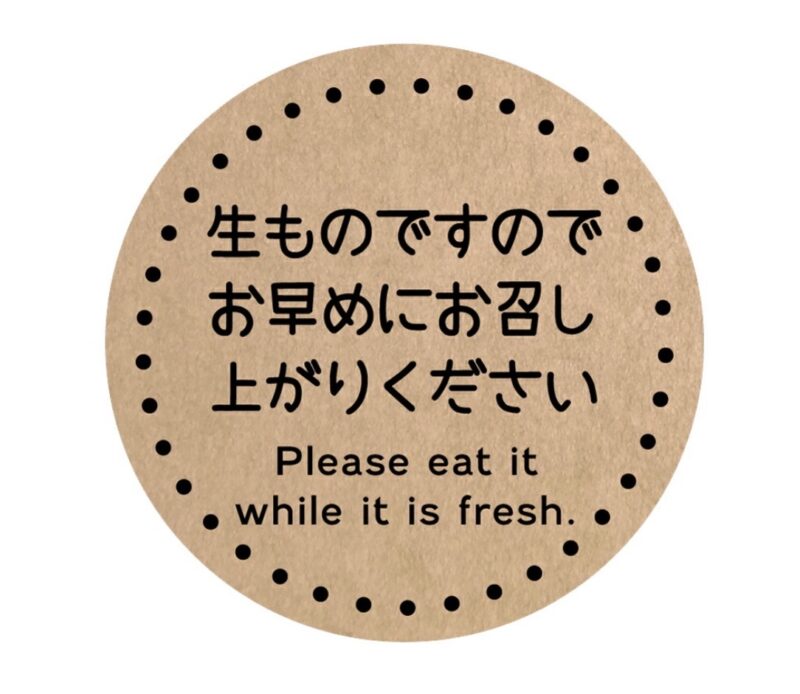
ケーキを買うと、箱にこんなシールがついてきますよ♪
市場 しじょう→経済的・金融上のマーケット
いちば→生鮮食品や日用品を取引する具体的な場所
人気 にんき→評判が高いこと オラは人気者〜♪とか
ひとけ→人間の気配 人気のない夜道、など
角 かど→折れ曲がったところ 街角、机の角など
つの→動物の頭に生えているもの 鹿やうしの角
繰り返しますが、音読み、訓読みなんて
全然気にしなくていいですからね!
私たちも分かってないですから(笑)
同じ漢字で読み方が違うと言えば「数詞」なんかもそうですね
匹、本、杯、羽。。。
梅雨だけに、蛙(かえる)が一匹(いっぴき)二匹(にひき)
三匹(さんびき)。。。
傘が一本(いっぽん)二本(にほん)三本(さんぼん)。。。
梅酒が一杯(いっぱい)二杯(にはい)三杯(さんばい)。。。
お、でも法則があるっぽい!と思って喜んだら
ホトトギスが一羽(いちわ)二羽(にわ)三羽(さんば)。。。
見事に期待は打ち砕かれます
流れからして(いっぱ)じゃん!
でもま、いっぱでも通じますよ
雨宿りをする人が、一人(ひとり)二人(ふたり)三人(さんにん)
…ってなんなの?!

あと数字自体の読み方も、後ろの数詞によって変わったりします
特に4、7、9の数字は
四個(よんこ)七枚(ななまい)九階(きゅうかい)
だったりするのに時間の読み方になると
四時(よじ)七時(しちじ)九時(くじ)。。。
数字を1から10まで数える時と、10から1に下がって数える時で
読み方変わるの知ってますか?
1〜10は いち、に、さん、し、ご、ろく、しち、はち、きゅう、じゅう
10〜1は じゅう、きゅう、はち、なな、ろく、ご、よん、さん、に、いち
で4と7が変化するんですよ〜
はち(8)、しち(7)や し(4)、に(2)を
聞き間違えるとカウントダウンで困るので、
放送業界などでも「なな」「よん」と
発音するようルールで決まっているそうです
多くの人はそんなルールなんて知らないけど
ちゃんとルール通り数えているという…
疑問に思う前に聞き慣れすぎて、馴染んじゃったんですよ
実際、こういう読み方の違いに文句言ってる日本人
聞いたことないですもん
テレビをつければアナウンサーが
『こんばんは 7時(しちじ)のニュースです』
『9時(くじ)になりました ニュースをお伝えします』
と言ってるのを毎日毎日聞いてましたから
(ななじ)や(きゅうじ)なんて違和感しかないです
だから語学の勉強は、なるべく自然に覚えられるように
積極的にリスニングを取り入れた方がいいですよね!
私自身も、スペイン語を勉強するのに毎日ポットキャストを
聞いています!おかげで自然な言い回しなどが身についてきてる
気がします。問題集を解いていて、迷ったときは
「どれが1番自然に聞こえるか」を重要視するようになりました
インプットのデータが蓄積されてきたように思えるからです
日本人の友達にN1の試験問題を解いてもらった時も
当然解けるんですけど、もちろん文法の説明はできません
間違いを選ばなかった理由を聞いたら「ヘンだから」
「そうは言わないから」でした(笑)
ポットキャストは何かしながら聞けるのがいいところだと思いますね
私は、洗面所にBluetoothスピーカーを置いてスマホとつなぎ
スキンケアやメイクをしながら聞いています♪
もちろん通勤時もイヤホンで!無料でこんなに
ネイティブから学べるなんてありがたいことです
みなさんも学習の一助にポッドキャストを
有効活用してみませんか?例外ばかりのルールに
真面目に向き合うもんじゃありません
何度も聞くことで自然に身につくこともありますから♪
The title uses the same kanji, 「梅雨」, but each one is read differently.
One is pronounced tsuyu-iri (the start of the rainy season), and the other is baiu zensen (the rainy-season front).
I imagine this is the kind of thing that often confuses Japanese learners.
This is related to the difference between onyomi (Chinese-derived readings) and kunyomi (native Japanese readings).
I imagine this is the kind of thing that often confuses Japanese learners.
This is related to the difference between onyomi (Chinese-derived readings) and kunyomi (native Japanese readings).
But honestly, you don’t need to worry too much about the technical terms.
To put it simply, onyomi readings are based on pronunciations that came from China, while kunyomi readings are native Japanese words that were later matched with kanji.
I suppose we Japanese learned all of this in school, but most of us don’t consciously think about it.
It’s usually more like:
“It has okurigana, so it’s probably a kunyomi reading.”
or
“It’s a compound word, so it sounds like an onyomi reading.”
There are actually quite a lot of cases where the same kanji can be read in different ways.
And sometimes, a different reading can even change the meaning of the word entirely.
But because we hear these words so often in everyday life, we tend to learn them naturally without much effort.
Unlike practicing kanji writing, we simply pick them up along the way.
◇ Words with nearly the same meaning
昨日 — kinō / sakujitsu
Both mean “yesterday.” Sakujitsu is more formal.
今日 — kyō / konnichi
Both mean “today.” The greeting konnichiwa originally comes from this kanji.
明日 — ashita / asu / myōnichi
All mean “tomorrow,” although they differ slightly in formality and usage.
◇ Words whose meanings change depending on the reading
- 十分
- juppun — ten minutes
- jūbun — enough; sufficient
- 一日
- tsuitachi — the first day of a month (for example, April 1st)
- ichinichi — one day; a full day; 24 hours
- 生物
- seibutsu — a living thing; biology
- namamono — uncooked or highly perishable food
- When you buy a cake in Japan, you may see a sticker with this word on the box.♪
- 市場
- shijō — a market in the economic or financial sense
- ichiba — a physical marketplace where food and everyday goods are bought and sold
- 人気
- ninki — popularity; being well-liked
- hitoke — the presence of people
- For example:
- Ninki mono! = “I’m popular!”
- Hitoke no nai yomichi = “a deserted road at night”
- 角
- kado — a corner or an edge, such as a street corner or the corner of a desk
- tsuno — a horn or antler on an animal’s head
Like I said, you really don’t need to worry about onyomi and kunyomi.
Most Japanese people don’t think about them that much, either.
Another good example is Japanese counters.
The kanji may stay the same, but the pronunciation changes depending on the number.
For example:
- ippiki (one small animal), nihiki (two), sanbiki (three)
- ippon (one long object), nihon (two), sanbon (three)
- ippai (one cup or glass), nihai (two), sanbai (three)
Since we’re talking about the rainy season…
A frog: one frog (ippiki), two frogs (nihiki), three frogs (sanbiki)…
An umbrella: one umbrella (ippon), two umbrellas (nihon), three umbrellas (sanbon)…
And of course, umeshu (plum wine): one glass (ippai), two glasses (nihai), three glasses (sanbai)…
You might even start feeling happy because it looks like you’ve found a pattern!
Then along comes:
A cuckoo: one bird (ichiwa), two birds (niwa), three birds (sanba)…
And just like that, your hopes are completely crushed.
Going by the pattern, it should be ippa, shouldn’t it?!
But honestly, if you said ippa, people would probably understand you anyway.
And then there are people taking shelter from the rain:
one person (hitori), two people (futari), three people (sannin)…
Wait… what?!
And the fun doesn’t stop there.
Even the numbers themselves can change pronunciation depending on what comes after them.
The numbers 4, 7, and 9 are especially tricky.
For example:
- yonko (four items)
- nanamai (seven sheets)
- kyūkai (the ninth floor)
But when telling time, they suddenly become:
- yoji (4 o’clock)
- shichiji (7 o’clock)
- kuji (9 o’clock)
And here’s another interesting one.
Did you know that Japanese people often pronounce some numbers differently when counting down?
Counting up from 1 to 10:
ichi, ni, san, shi, go, roku, shichi, hachi, kyū, jū
Counting down from 10 to 1:
jū, kyū, hachi, nana, roku, go, yon, san, ni, ichi
Notice how 4 and 7 change from shi and shichi to yon and nana.
The reason is simple: shi can sound similar to ni (2), and shichi can sound similar to hachi (8).
In a countdown, that could cause confusion.
That’s why broadcasters and other professionals are generally taught to use yon and nana instead.
Most Japanese people don’t even know there’s a rule like that.
We just follow it naturally.
We’ve heard these pronunciations so many times that they simply sound normal to us.
In fact, I don’t think I’ve ever heard a Japanese person complain about these reading differences.
If you turn on the TV in Japan, you’ll hear announcers saying things like:
“Good evening. This is the 7 o’clock news.” (shichiji)
or
“It’s now 9 o’clock. Here are today’s headlines.” (kuji)
We’ve heard those pronunciations every single day for years.
To me, nanaji (7 o’clock) and kyūji (9 o’clock) just sound strange.
That’s why I think it’s important to include plenty of listening practice when learning a language.
The more naturally you can absorb the sounds of the language, the better.
I’ve been studying Spanish myself, and I listen to podcasts every day.
I feel like it’s helping me pick up natural expressions and ways of speaking.
These days, when I’m working through exercises and I’m not sure about an answer, I often ask myself:
“Which one sounds the most natural?”
I think that’s because I’ve gradually built up a large amount of input over time.
I once had a Japanese friend try some questions from the JLPT N1 exam.
Of course, they got the answers right.
But could they explain the grammar?
Not at all. 😆
When I asked why they didn’t choose the wrong answer, the response was usually:
“Because it sounds weird.”
or
“Nobody says it that way.”
And honestly, that’s often how native speakers know.
One thing I like about podcasts is that you can listen to them while doing other things.
I keep a Bluetooth speaker in my bathroom and connect it to my phone, so I can listen while doing my skincare routine or putting on makeup.♪
And of course, I listen through earphones while commuting as well.
It’s amazing that we can learn so much from native speakers for free these days.
So why not make podcasts part of your study routine?
After all, rules that are full of exceptions aren’t worth overthinking. Sometimes, things simply sink in after you’ve heard them again and again.♪